
PA Program Receives Hands-on Trauma Training with the United States Army
In the 1960s, a physician shortage posed a critical healthcare threat in the United States. At the same time, medics were returning from the Vietnam War with intensive trauma training and experience that made them overqualified to work as paramedics. Doctors at Duke University began to enroll these veterans in an accelerated medical education program, and from there, the Physician Assistant profession was born.
Tactical training still bolsters the curriculum of some physician assistant programs, such as Assumption’s, today. As part of the general surgery course, PA students were recently led in a Tactical Combat Casualty Care (TCCC) training led by United States Army personnel, including associate professor of human services Gary Senecal, an Army Reserve captain with thirteen years of military service.
“This course is designed to be at the end of the didactic year, after students have had some emergency medicine and surgery classes,” says Christopher Ferreira, PA-C, program director of PA studies. “This knowledge can be applied to any setting, but it’s what the military uses to train field trauma. Instead of doing things the way we normally would when everything’s nearby, this is training for situations you need to address emergently to save someone’s life.”
The first day consisted of classroom training to prepare students for the exercise, in which they would be tasked with responding to blast and burn injuries following a simulated explosion. During the exercise, the Richard J. and Sophia Catrambone Health Sciences Center became a triage center for the students to treat the injuries in.
“The scenario had half the class scattered outside Catrambone, waiting to be treated. The other half of the class was the rescue team,” says Ferreira. “Those students would go out, find people, bring them into the lab on the third floor, triage them, and run the floor like a triage hospital.”
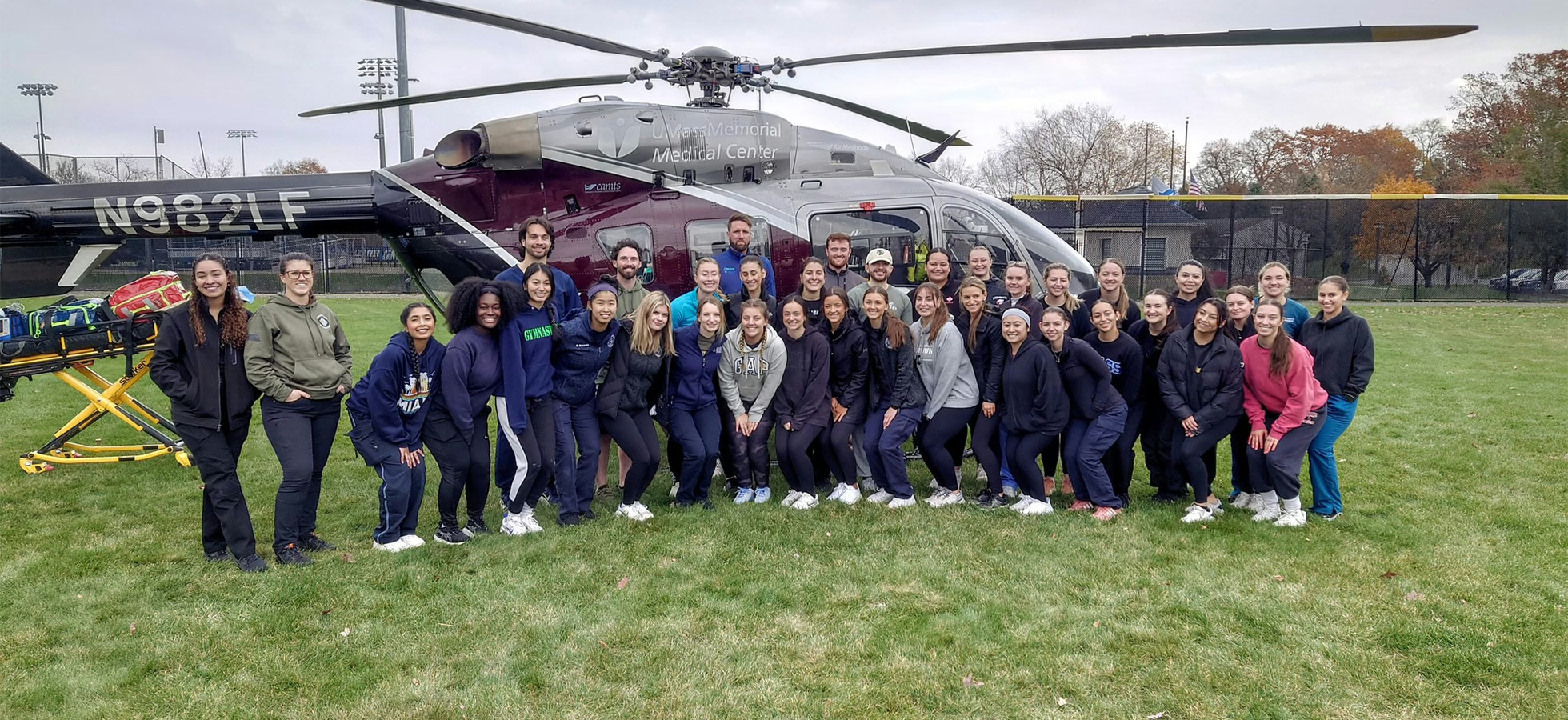
The PA students, along with some nursing undergraduates, accelerated Bachelor of Science in nursing students, members of Assumption’s Pre-PA club, and other undergraduates played the part of the injured, with makeup simulating wounds. Massachusetts Maritime Academy was on site with an ambulance, and a UMass Life Flight helicopter landed on Rocheleau Baseball Field, allowing students to network with the crew and observe the helicopter’s equipment.
PA student Veronica Leonardo, who has been a military medic in the Rhode Island Air National Guard for a decade and has helped to lead trainings like these in the past, helped facilitate the exercise.
“I was excited to have my class see what my background is and how the military functions,” Leonardo says. “At the same time, I was a little nervous—I do this with the military, but it’s different when you’re doing it with your own classmates.”
Leonardo was one of four PA students with important roles during the training. Allison Solomon, who was an EMT for six years before PA school, and Allison Florentino, who worked in athletic training for 10 years, each led one of the two teams. Olivia Gamache, a paramedic with ten years of experience—and the current PA class president—worked alongside Solomon and Florentino to help triage patients.
Being split into two groups for the training was beneficial, Gamache said, because the groups were able to learn from each other as they moved through the exercise.
“The first group didn’t have anything to emulate; they responded in the moment,” Gamache says. “The second group observed and tried something different to see if it was better. That’s how it’s supposed to happen—you learn from everything and build upon that knowledge.”
“When you’re going out into the field, and you get activated, you’re not going to have pre-planning or preparation. It’s chaos, but you will figure it out,” Leonardo says.
“That’s the point of the scenario,” Solomon agrees. “To fail, and have it be messy, especially when nobody’s actually dying, so we could learn.”
“Emergency medicine is something that should be important to all medical providers,” Florentino says. “I’d rather be overprepared by having done something like this than underprepared and in a state of shock when seeing it. You never know where or when something is going to happen. Catrambone was set up as our treatment center, and was it ideal? No. But the training, for me, was about learning how to adapt to make it the best possible situation.”
“If you can learn to care for patients with the bare bones, it makes you a better provider,” she continued.
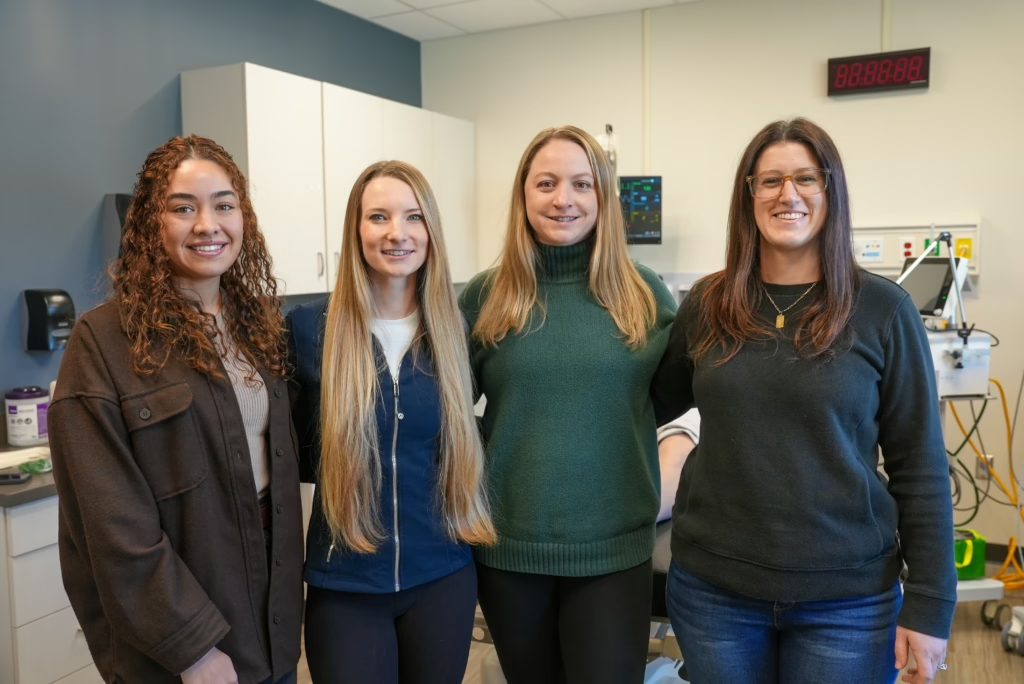
In January, the PA program’s inaugural cohort will transition from didactics to 16 months of clinical rotations offsite, applying their classroom studies to real-world training. Leonardo will be going to Rhode Island for her orthopedic surgery rotation; Florentino will be at UMass Memorial Health – Harrington Hospital for her inpatient medicine rotation; Solomon will be beginning with her ophthalmology and ENT (ear, nose, and throat) rotation; and Gamache will be on Block Island for her family medicine rotation. Each rotation will last five weeks, and then the students will switch to one of 13 different clinical rotation sites.
A new cohort of PA students will also begin their education at Assumption in January—and, like the first class of students, will complete their didactic year with TCCC training. Leonardo is already planning on leading again this year, and Ferreira says that seasoned, second-year PA students are eager to assist with this new tradition after finding it so valuable.