
BookTok, Lasers, and Loss: Honors Program Brings Catholic Liberal Education to Bear on a Broad Spectrum
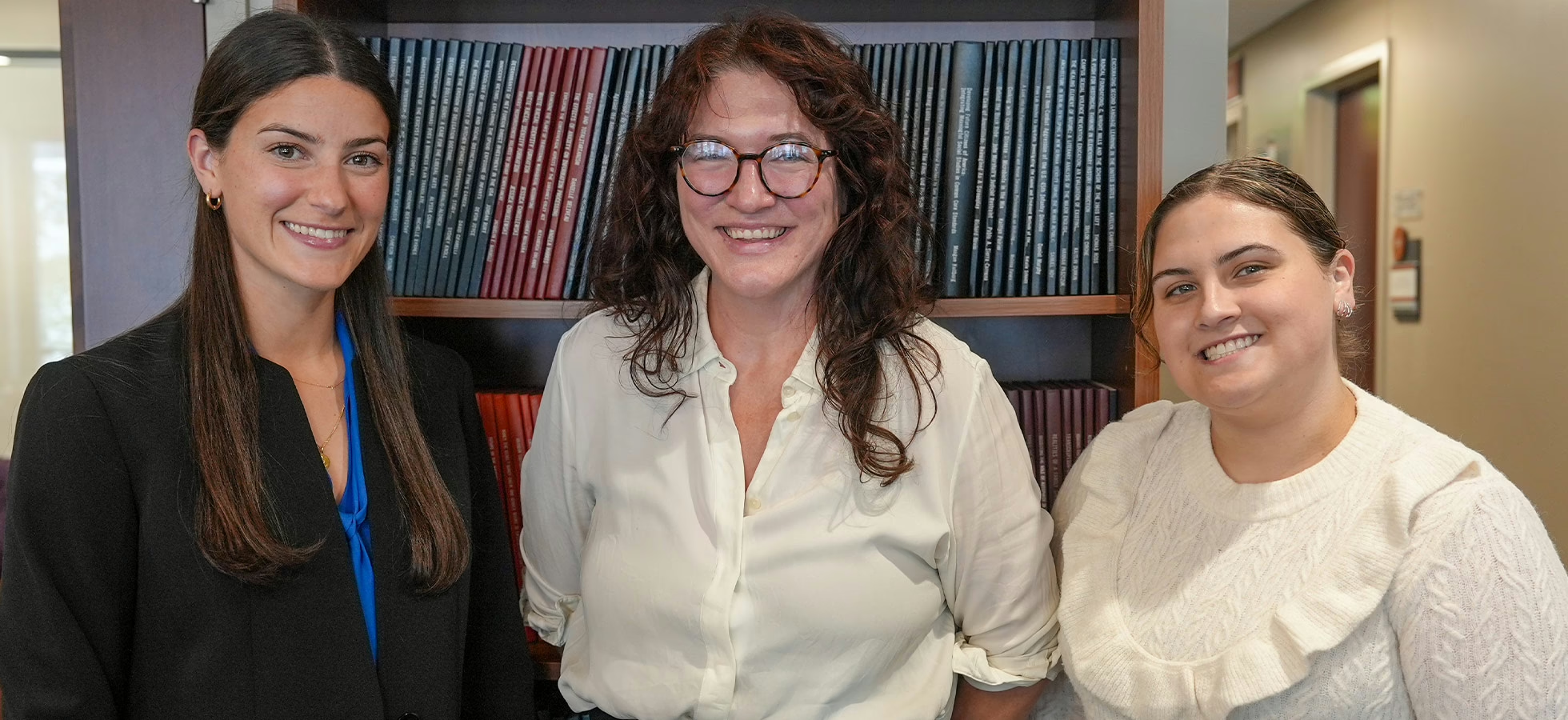
Assumption’s Honors Program was established for striving students to further their education with specialized advanced courses and the opportunity to partner closely with a professor on in-depth research in a field of that student’s choosing.
“A core strength of the Honors Program is a core strength of Assumption—community,” says Rachel Coleman, assistant professor of theology. “I think it’s remarkable that every time I’m in the honors lounge, there’s a ton of students hanging out. They start looking out for each other as soon as they start taking classes together. And professors enjoy adding the personal touch, working closely with mentees, because they want to invest in our students. These strengths are not divorced from Assumption’s general strengths—they’re grounded in who we are.”
This fall, Coleman was named the new director of the Honors Program—a position for which she is uniquely qualified. She not only holds a Ph.D. in theology, but bachelor’s degrees in biology and philosophy as well as a master’s degree in theological studies with a concentration in biotechnology and ethics. Coleman says this interdisciplinary background helps when teaching Honors 300, where juniors choose their final honors thesis subject.
“The senior honors project seems like this big scary thing, but it’s actually the coolest, because they get to work with a professor of their choosing on a project that they want to do—whatever topic they want,” says Coleman. “In teaching the Honors 300 course, I have to become a mini expert to help the students develop their thesis projects. I like teaching it, too, because I enjoy learning new things and seeing what our students are really interested in.”
Previous honors projects have included writing a novel, constructing a laser, composing a piece for the pipe organ, and penning research papers on esports, TikTok book marketing, and countless other niches.
The honors thesis is the culmination of the program, which consists of seven courses. Most honors students begin their first year at Assumption with two classes per semester in Honors Foundations Learning Communities with fellow honors students, fostering strong social and academic connections as soon as they arrive on campus. The program continues with one course per year, including the thesis project for seniors. All theses are bound and placed in d’Alzon Library, as a permanent symbol of students’ contribution to scholarship on Salisbury Street.
This fall semester, two honors students defended their thesis projects to the Assumption community, successfully completing their honors program requirements, and enshrining their research in the Assumption archives.
The Uses of Sorrow: Maturing Through Writing About the Loss of a Parent
Taylor Adduci ’26, an English major, worked closely with faculty mentor Lucia Knoles, professor of English, to write her honors thesis.
Adduci said the topic of her project came from a discovery process where she delved into multiple memoirs, inspired by works she read her first year that focused on finding meaning.
“I do not lightly accept challenges like this,” Knoles said as she introduced Adduci at the thesis defense. “But when Taylor asked, I did not hesitate. Teachers say this but often do not mean it—I have learned as much from her as she has from me.”
Adduci’s project explored three memoirs—Coming Home Again by Chang-Rae Lee, Not Becoming My Mother by Ruth Reichl, and Without a Map by Meredith Hall. In each, the author wrote about experiences with the loss of a parent with whom they had conflict. Adduci examined how each author reconciled with their parent, either before or after their death.
“Continued conversations with deceased loved ones do not end unless we end them,” Adduci said. “Death can be uncomfortable, but it sparks a necessary conversation.”
Adduci is considering law school after her graduation in May.
The Rise of GLP-1 Receptor Agonists and Their Effect on the American Obesity Crisis
Meghan Witt ’26, a biotechnology and molecular biology double major, worked with Professor Steven Theroux on her honors thesis. Her project focused on GLP-1 Receptor Agonists, medications known as brand names such as Ozempic and Wegovy, and whether the rate at which the drugs are being prescribed to patients is appropriate.
Witt began her project with an exploration of the rates of obesity in America and the portion of the population already taking GLP-1 medications. She focused her research on Ozempic, finding safety risks associated with taking the medication of which the general population may not be aware. Additionally, while 13% of the population reported having taken a GLP-1, the drug only lowered the obesity rate in the United States by 1.3%.
Witt concluded that GLP-1s should remain on the market, but that there should be an increase in educational opportunities for patients, and it should not be given to populations under the age of 18. She confirmed that her opinions on GLP-1s changed through her research. “I know this medication isn’t just a band-aid, and I realized that drugs like these could be a start of a solution to the problem of obesity.”
Witt is currently enrolled in the 4+1 biotechnology and molecular biology program and is taking master’s level courses at Northeastern University alongside her undergraduate courses at Assumption. She will earn both a bachelor’s degree in biotechnology and molecular biology from Assumption and a master’s degree in biotechnology from Northeastern once she completes the program.