
Center for Civic Friendship Hosts Doris Kearns Goodwin for First Major Public Event
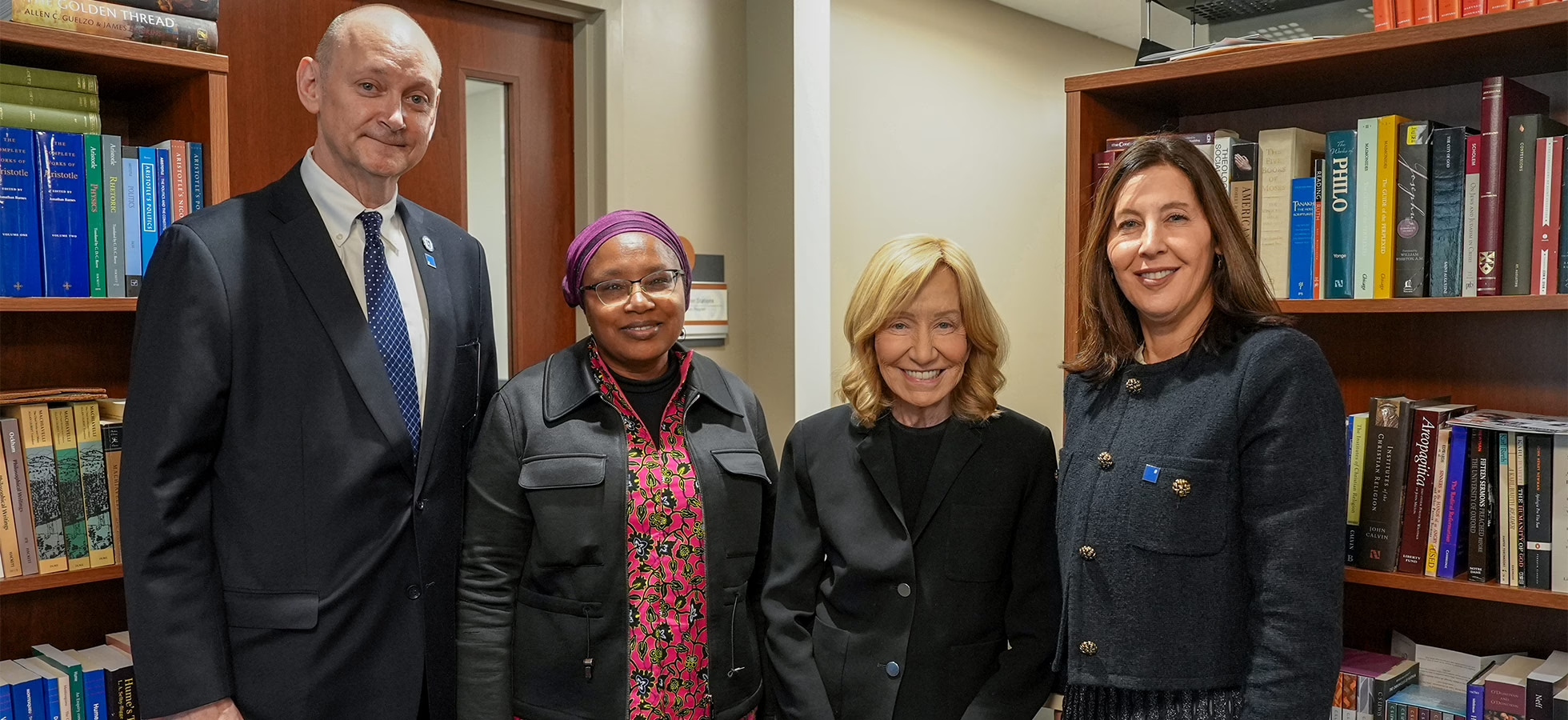
Pulitzer Prize-winning presidential historian Doris Kearns Goodwin joined Assumption President Greg Weiner for a wide-ranging conversation about her bestselling novel Team of Rivals: The Political Genius of Abraham Lincoln, civic friendship, leadership, ambition, resilience, and sports on March 26.
The conversation was the first major public event for Assumption’s Center for Civic Friendship, and more than 400 members of the Assumption and Greater Worcester communities attended to hear Goodwin and Weiner speak about the greatness and leadership of President Abraham Lincoln.
Prior to the conversation, Goodwin spoke with Assumption’s Civic Friendship scholars and the Center’s Inaugural Fellow Alice Nderitu about the work being done at the Center. This work includes student-led debates, meetings with faculty and scholars that explore approaches to civic friendship, and the Civic Friendship Playbook, a new initiative drawing on the culture and values of sports to foster connection, inclusion, and shared purpose.
“We’ve got so much to depend on in the next generation, and if today’s students are an example, then I think we’re going to be in good shape,” Goodwin said about the scholars during the event later that evening.
To open the public conversation, Director for the Center for Civic Friendship Mary Jane Rein emphasized how important civic friendship is, especially during this political moment.
“We know that we are living in polarizing times. Yet it is important to remember that our nation has overcome even more troubling divisions in the past,” she said. “That is why we are here tonight—to reflect on the enduring virtues of judgment, humility, and civic friendship, which we need now as much as ever.”
Rein then introduced Goodwin and Weiner, who began their conversation by speaking about vocation. Goodwin spoke about how she used to love to narrate Brooklyn Dodgers games to her father when he returned from work, and later how a teacher in high school made history feel alive, and how both of those times led to her becoming an historian.
Weiner asked Goodwin about members of Lincoln’s cabinet and how he was able to keep a team of ambitious men with such differing opinions together, identifying them as a robust example of civic friendship.
“The idea of our Center for Civic Friendship is to create a national model for disagreement being not only polite, but also productive, because it’s situated in the trusting confidence that we’re disagreeing about what are ultimately shared ends,” Weiner said. “Team of Rivals is such a wonderful example of that—Lincoln surrounds himself not only with men who sought the presidency, but who continued to feel they were better suited for it.”
Goodwin said that Lincoln chose Bates, Chase, and Seward, who had all previously run against Lincoln in the 1860 election, for his cabinet because he realized that he did not have enough knowledge on his own. She also contextualized the way in which he was able to work with them, and other leaders like Frederick Douglass, who possessed different priorities.
“What you need to do is to figure out the context in which the person you’re talking to is coming from, understand that, and then see why they may have a different opinion than you,” Goodwin said. “It’s that grace of understanding what the person is under—what are the constraints they have because of where they’ve come from, how they feel because of what their responsibilities are—and where are my freedoms because of where I’m at? And how can we talk about them together?”
To conclude the conversation, Goodwin and Weiner took questions from the audience. Questions ranged from the role of technology in leadership, to the habits of mind that helped Lincoln get through the period of the Civil War, to the importance of history in education.
Goodwin emphasized the importance of history, saying that though the presidents didn’t know how things would turn out when the country was in peril, such as during the Civil War and the Great Depression, they remained steadfast.
“History is absolutely essential now—more than ever before, I think, to teach us that we can have hope,” she continued.
This event was part of Assumption’s celebration of America’s semiquincentennial, Striving for Life, Liberty, and the Pursuit of Happiness: 250th Anniversary of the Declaration of Independence. The next event in the series will be a public reading of the Declaration of Independence and panel discussion on Thursday, April 23, at 5:00 p.m. Visit Assumption’s semiquincentennial celebration webpage for more information about future events.