
Second Foundations Lecture Examines Incredible Complexities of the Human Voice
The second event in the Foundations Lecture Series saw a lively discussion about the intricacies of speech. It was held on Wednesday, February 4, featuring panelists Alison Myette, associate professor of practice in human services; Margaret Tartaglia, adjunct faculty in art and music; Michele Lemons, professor of biology; David Thoreen, professor of English; and Rachel Ramsey, associate professor of English as moderator. The panelists touched on topics such as how speech works, how it is interpreted by the brain, and how it compares to the singing voice.
Myette, who has been a practicing speech language pathologist since 1995, opened the lecture by scientifically defining speech and explaining the five systems that work together in the human body to create speech: the respiratory, phonatory, articulatory, auditory, and nervous systems.
“Sound is a pressure wave that is created by a sound source. That sound source is going to disturb air particles, and that disturbance is going to carry acoustic energy from the sound source across a space or the environment,” she said.
In addition to her teaching practice, Tartaglia, who is a former opera singer, is also certified as a singing voice specialist and patient advocate. She works on vocal health teams to help professional voice users, such as singers, who experience vocal disorders and dysfunctions.
Bringing that expertise to the Foundations Lecture, she explained the difference between what happens in the body during regular speech and singing. For example, when someone is singing, the vocal folds, or cords, move faster than they would during regular speech.
Lemons, a neuroscientist, explored how structures in the ear and the brain allow humans to hear and interpret sound.
“Isn’t it amazing to think about this? All of these small cells, particles, and muscles…so many things are happening for us to generate a voice and to hear that voice,” she said. “I hope that complexity inspires a sense of wonder, because it really is fascinating—speech isn’t just molecules and muscles and airwaves. Speech is beautiful. It is used as an art form. It can invoke feelings of joy, and sadness, and it’s an amazing tool we have.”
As a demonstration of the power of speech, Thoreen then read aloud one of his own published poems, “Shuttle”. He encouraged the audience to listen to the words in the poem, especially for repeated sounds and rhymes.
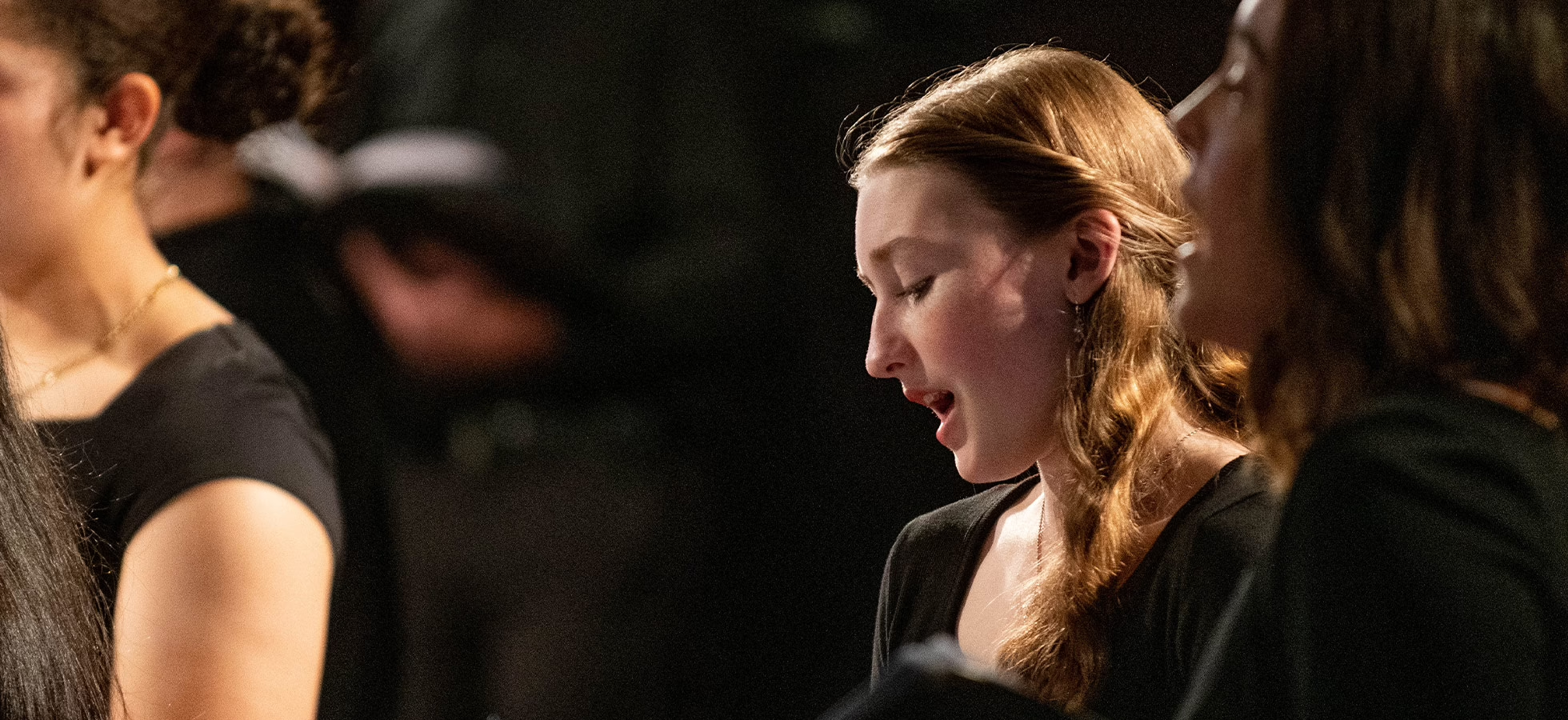
To emphasize the difference between speech and singing, Tartaglia showed a clip of three students from her advanced voice class—Claire Pastrone ’26, Westin Michaud ’29, and Joe Harrahy ’27—singing a few lines of “Shuttle” set to an English folk song.
Tartaglia, Lemons, and Myette then all spoke from their respective disciplines about the differences between song and speech—how singing uses more pitches than speaking, how the brain processes each form of sound, and what the same word both spoken and sung look like in soundwave form.
“It’s much more complicated to speak, and to hear, and to sing, and to write poems than one might imagine,” Ramsey offered as moderator. “There’s so much to learn and connect, and what we might take for granted is that what we might be doing right now, speaking, involves our whole body and brain in many ways.
“As we were talking about this process, after I had been teaching all day, Professor T[artaglia] made a comment about how I was straining my voice because I hadn’t taken care of this really valuable tool that lets me do so many things,” she continued.
Tartaglia concluded the presentation by emphasizing that point. She spoke about phonotrauma, or vocal cord damage, and how to prevent it—through hydration, maintaining a good diet and exercise, and the limiting of overuse and abuse on our voices, like yelling.
“Your voice is the ultimate tool,” Tartaglia said. “It says a lot about you—it shows your personality, and it identifies you. It is important to take care of your voice, even though it’s something we don’t think about on an everyday basis.”
The Foundations Lecture Series is a forum for professors across disciplines at the University to come together and show the fruits of a Catholic, liberal arts education. To learn more about the series, view photos, and watch the entire lecture, visit the Foundations Lecture Series webpage. The next Foundations Lecture Series event will be held on September 9 as a part of Assumption’s celebration of America’s semiquincentennial.