
London Calling: Honors and CTEQ Students Take Spring Break Trip Abroad
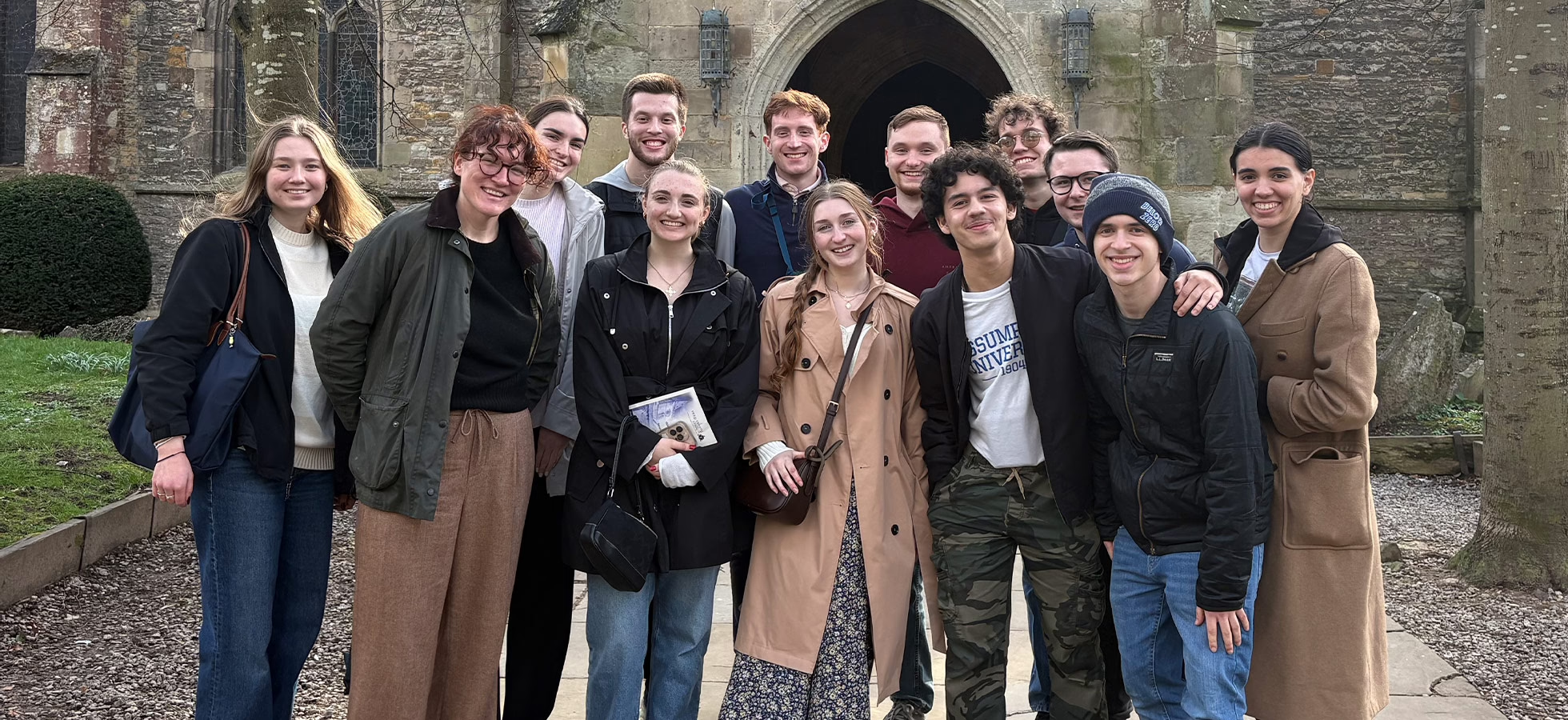
“By seeing London, I have seen as much of life as the world can show,” wrote eighteenth-century writer and polymath Samuel Johnson. And, while the Assumption students who traveled there over spring break might not agree with the finality of Johnson’s words, they certainly agree with the city’s expansive capacity for intellectual enrichment.
Those who went on the trip, including Ella Bradshaw ’27, affirmed that London opened their eyes to the breadth and grandeur of the world.
“Any traveling experience, I think, can do that,” says Bradshaw. “But one with academic connections was especially important. I had never been to Europe, and the idea of doing it in the company of other students, and with professors, really excited me.”
In all, twelve students enrolled in either Assumption’s Honors or Core Texts and Enduring Questions (CTEQ) programs made the journey to London alongside Rachel Coleman, assistant professor of theology and director of the Honors Program.
CTEQ, which exists to expose students to core texts and authors in the Western Canon, such as Samuel Johnson, also holds the strategic goal of exposing students to travel abroad. Daniel Maher, professor of philosophy and CTEQ program director, has historically also invited Honors students to join the CTEQ students traveling.
This year’s itinerary included meaningful sites like Stratford-upon-Avon, where Shakespeare was born and died, the University of Oxford’s Bodleian Library—one of the oldest European libraries, founded in 1602, St. Paul’s Cathedral, and the National Gallery.
“These sites were the connecting blocks to their actual education—in particular, CTEQ courses, but not just those—all of their classes at Assumption,” says Coleman. “Those were the moments where what they had learned became less abstract.”
“The trip was a great way to apply what we learned in the classroom to our lives and to see how it all relates,” Bradshaw says. “A liberal education helps you to be a better traveler It helps you understand other cultures, philosophies, theologies, and ways of life, and even helps you to enjoy the experience more yourself.”
The National Gallery especially inspired conversations between the students, as they reflected on art that they had seen and learned about in their courses.
“There, they were able to experience art in person that you don’t otherwise have a chance to see with your own eyes, which produced a discussion later at dinner about whether it matters to see art in person or not,” Coleman says. “And because they had all taken art history courses, they could talk about these things in a really informed way.”
Art history is one of the core components of the CTEQ program, and both Bradshaw and Michael Klofft ’27 connected what they saw in art and architecture to their studies at Assumption.
“Taking a course on ancient and modern art and the question of beauty was so helpful for me in the city,” Klofft says. “I was able to look at some of the older architecture and understand what they were drawing on, or what the style of architecture is called.”
“Being in Europe, especially for the first time, and seeing these buildings that are older than our nation, was amazing,” Bradshaw says. “The first honors course I took at Assumption was art history, and walking in these old cathedrals and churches, seeing the interior design and architecture, thinking about how it was all built, I was able to draw upon so many things I had learned.”
Coleman, a distinguished Catholic theologian, had a unique perspective on the trip, saying she came face to face with what she had learned and understood about the English Reformation.
“I’ve known about the English Reformation in theory but experiencing it by being in these buildings that used to be Catholic…I’m going to be reflecting on that for a long time,” she says.
Bradshaw and Klofft, both double majoring in theology with another discipline—Bradshaw in political science and Klofft in music—shared similar sentiments.
“Visiting a Protestant nation and exploring Catholic cathedrals that had been transformed after the reformation was really moving,” Bradshaw says. “It’s one thing to learn about it in America, but to be in a giant cathedral and to see a statue of Saint Peter beheaded…I could feel the emotional pull.”
“Studying theology and Church history, it was interesting to see some of the Anglican churches and to be able to understand the historical references,” Klofft says. “You could see the influence of Protestant theologians around the city.”
Both Bradshaw and Klofft found that the most impactful part of the trip was not only the location, but the connections formed between the group—and they encourage other Greyhounds to take advantage of the opportunity to discover the world in the company of friends.
“That’s what I’ll remember the most, the experience of being with these people in this location,” Klofft says. “We all grew a lot closer.”