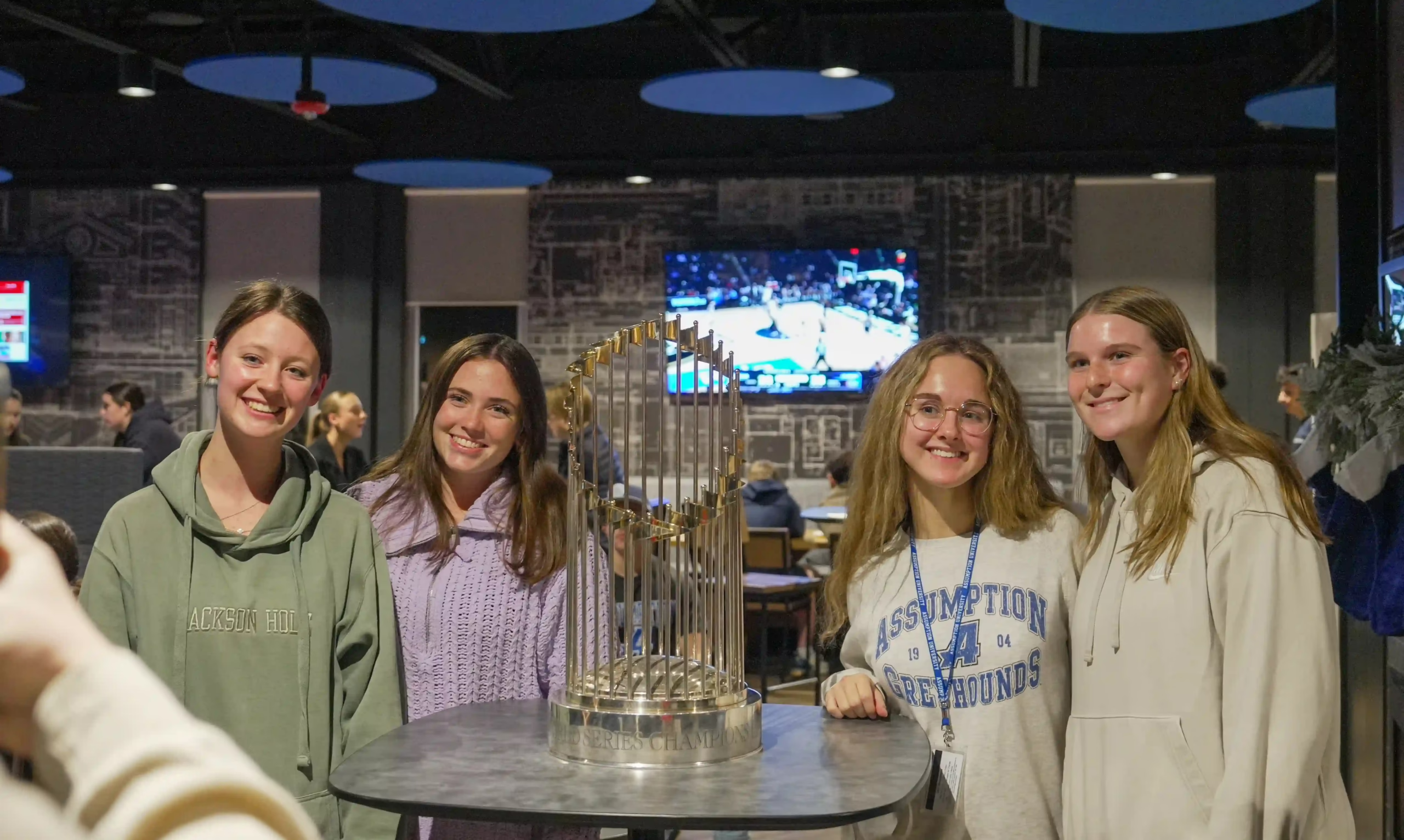
Center for Civic Friendship Launches Playbook Initiative with Red Sox Hall of Famer
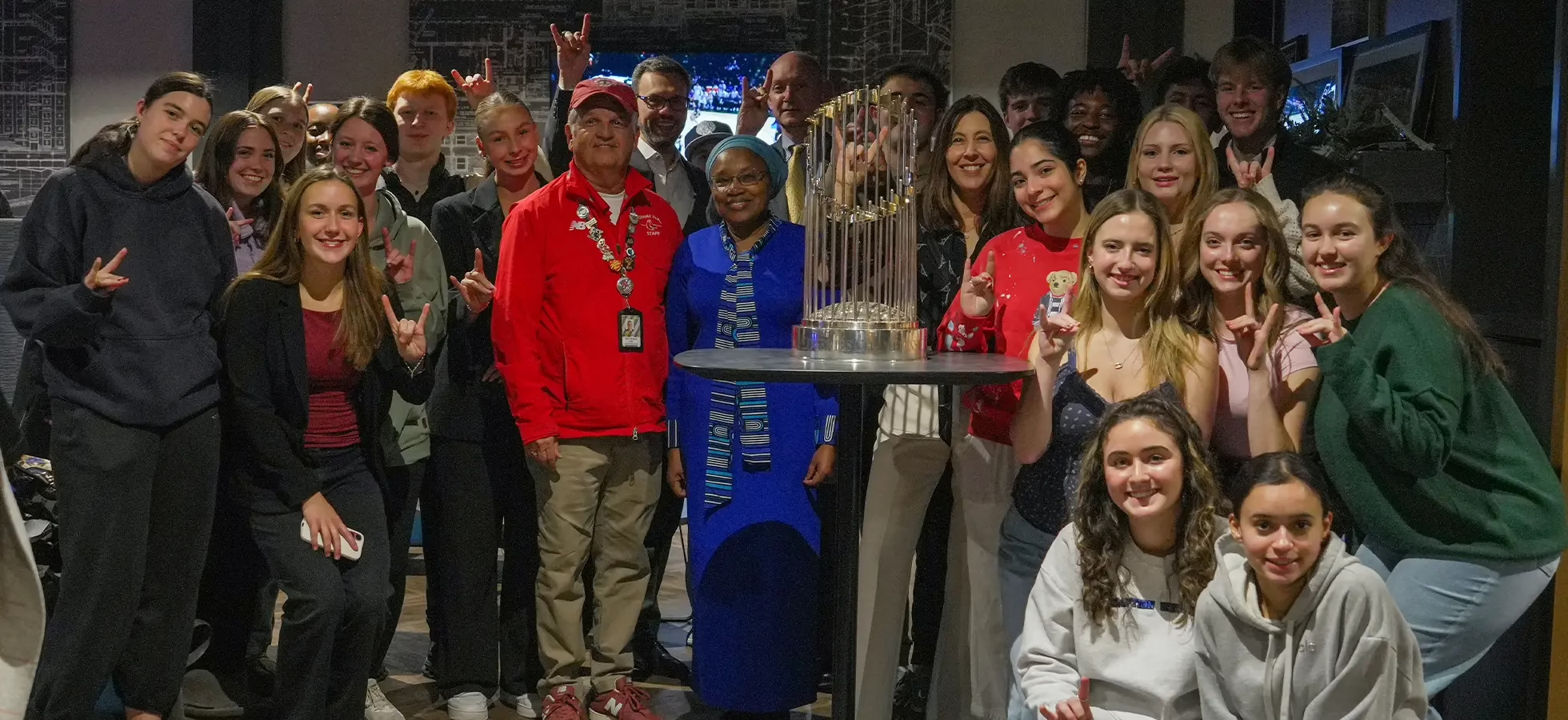
Assumption’s Center for Civic Friendship launched its Playbook initiative on November 17 with a panel discussion on how sports can form better relationships, stronger character, and more vibrant communities.
The Civic Friendship Playbook explores how lessons learned through athletics, including teamwork, perseverance, respect for opponents, and the pursuit of shared goals, can help students develop the habits of engaged and responsible citizenship.
The panel was moderated by Gary Senecal, associate professor of school counseling and chair of Assumption’s sports working group. Panelists included David Friedman, executive vice president for the Boston Red Sox; Rich Gedman, former Red Sox All-Star catcher and Hall of Famer; Ella Bianchi ’29, ballet dancer and Civic Friendship student; Rory O’Donnell ’26, football captain and graduate student; Krystle Robleski, director of sports performance and head athletic trainer; Sam Stoner, associate professor of philosophy; and Greg Walsh, associate professor of practice in sport marketing, management, and leadership.
Father Dennis Gallagher, A.A., vice president for mission, opened the evening by blessing the panel and the mission of the Playbook.
“Thank you for those at the Center whose inspiration lies behind the creation of the Playbook. May it redound to the benefit of our student athletes and coaches here at Assumption, find its deserved place within our wider educational mission, and extend its reach beyond the campus. As we gather tonight to speak with one another about the lessons of sports, keep us always humble in your service,” he prayed.
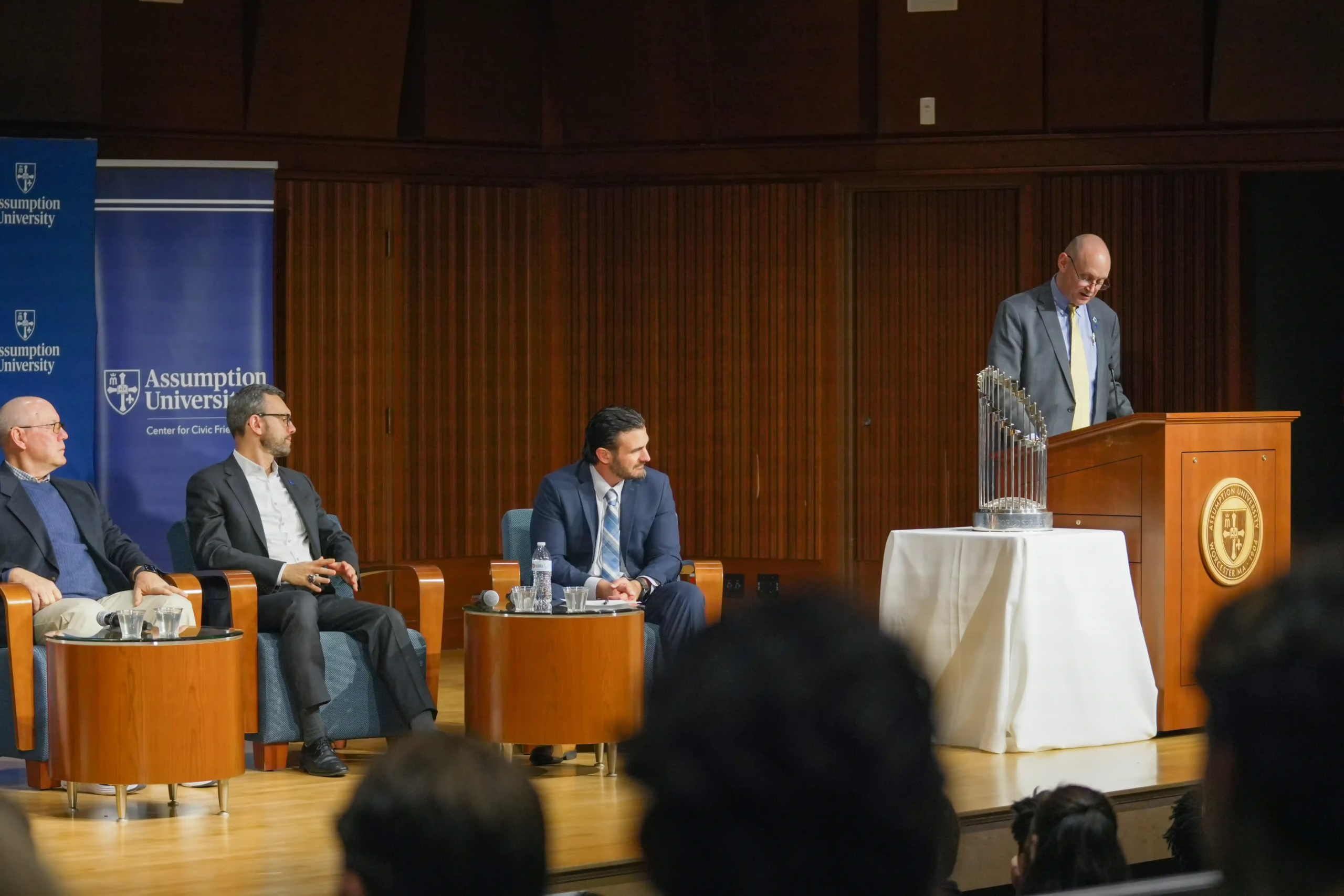
President Greg Weiner welcomed the audience to the launch event and invoked Pope Leo XIV’s recent letter “Life in Abundance,” which discusses the value of sports to our humanity.
“‘Sports does not divide. It brings people together,’” he said, quoting the Holy Father. “‘It does not focus solely on the result but values the journey. It does not idolize performance but recognizes the dignity of those who play.’ Pope Leo’s’s idea that sports can be a means of forming friendship and bonds as citizens, and of inviting people into the values of liberal education, is also central to a sister effort that will be closely intertwined with the Playbook—the Larry Lucchino Institute for the Study of Sports.”
The Institute will honor Larry Lucchino’s legacy by connecting the study of sports with liberal arts education, leadership, and civic life. The Institute, the Center for Civic Friendship, and the Playbook will all be closely intertwined as Assumption seeks to use sport as a way to promote the common good.
“Speaking as a political science professor, one of the most challenging concepts to teach students is the common good,” Weiner continued. “There is no better school for the common good, no better introduction, than the example we have from athletics.
“The best teams do not treat their opponents as enemies. The word compete, as we had inherited from Latin, means to seek together. If civic friendship sounds abstract, sports are where most of us have already practiced it,” he said.
He then went on to give the history of the Playbook, explaining that a group of civic leaders came together after the Tree of Life Synagogue was attacked by a gunman in Pittsburgh to build a framework for using the bonds of competition and fandom to counter hate rather than fuel it. Alice Nderitu, the Center’s inaugural fellow, helped chair the group that developed the framework, the UN & Eradicate Hate Global Summit Sports Working Group. The group included teams from major sports leagues across the country, including the Red Sox and Friedman, who worked closely alongside Nderitu.
The discussion began with a question for the panel: What is the greatest lesson sports have taught them about relationships?
Bianchi started the discussion by reflecting on how she had learned that ballet is less of an individual pursuit than people assume. She described her first lift with a new partner, saying, “He looked at me and he said, ‘Do you trust me?’ I said, ‘Sure, yeah.’ And he goes, ‘No, you don’t. But it’s okay. We’ll work on it.’” Over four months, she said, a foundation of friendship made it possible to take on more difficult moves.
When asked about hard lessons learned while being an athlete, Walsh recalled a college teammate who rarely played yet was the team’s most enthusiastic leader.
“For an entire season, he may have played for six or seven minutes,” he said. “But he was always so enthusiastic. He never held a grudge. He was our leader. Nobody is ever above the team.”
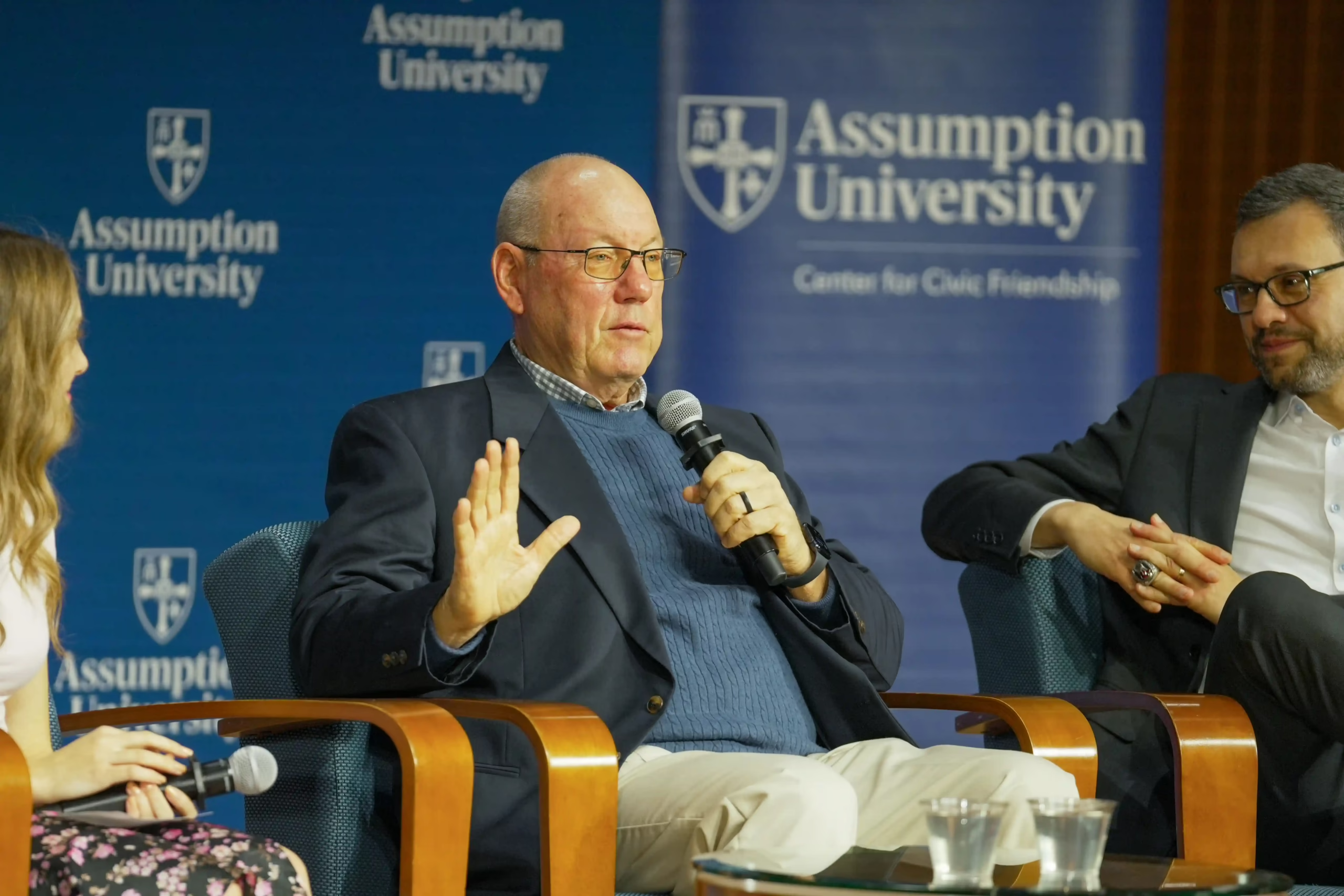
Rich Gedman at the Playbook event.
Gedman was asked about how leaders can bring people from different backgrounds together as teammates. He described walking into a clubhouse of players from the Dominican Republic, Venezuela, and across the United States. In that setting, he said, what mattered was not background but “your effort, your attitude, how much [this] means to you.”
Senecal, an Army veteran, drew a parallel to military service and asked how the clarity of purpose in intense teamwork might be brought to parts of life that are less clear-cut. Gedman’s answer was simple: listen to someone whose opinion differs from yours.
O’Donnell, who has played five years at Assumption, was then asked about the role leaders have in establishing culture. He said leadership is defined by consistency and accountability rather than titles. “Calling yourself a leader really doesn’t mean anything. It’s about what you do,” he said.
Robleski added that the culture handed down from one class to the next in Assumption athletics is something the University can share with other schools through the Playbook.
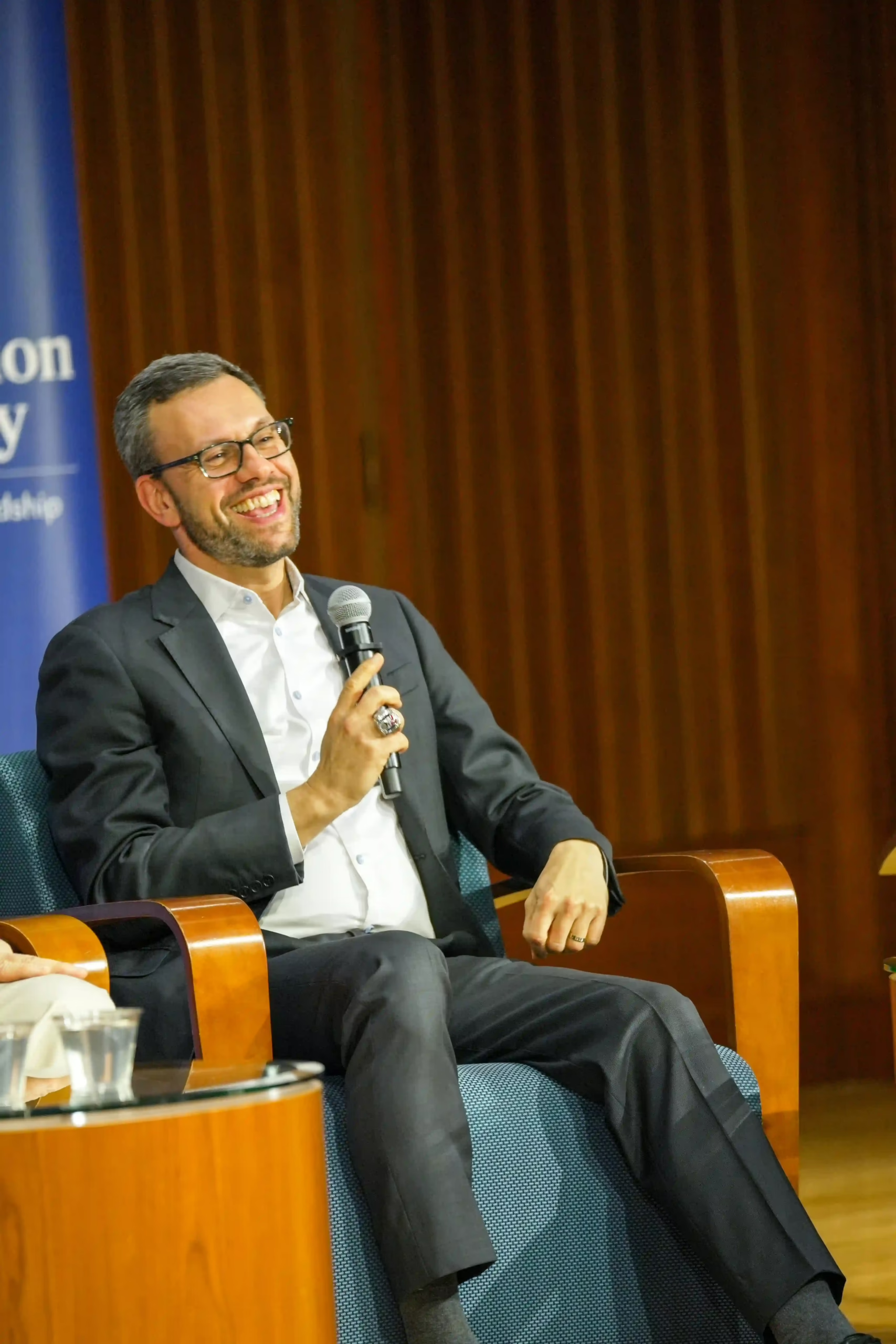
David Friedman at the Playbook event.
Friedman was asked about how sports teams can foster connection and community outside of their teams and said the Red Sox’s response to the 2013 Boston Marathon bombing remains his clearest example of a team bringing a community together. He also outlined steps any organization can take, such as controlling its venue so that hate speech does not go unchecked, responding to emergencies around the world, supporting charities such as the Jimmy Fund, and supporting inclusive celebration of culture and identity. “You can root against another team,” he said. “But don’t attack people based on their race or their religion.”
Stoner closed the discussion by drawing on Saint Augustine’s “Confessions” and the philosopher C. Thi Nguyen’s idea of “value capture,” in which money, fame, or status can displace the love of the game that first drew someone to a sport. He pointed to name, image, and likeness rules, sports gambling, and private equity in youth sports as examples. He also said Assumption’s emphasis on a whole, well-lived life is a bright spot, though it takes intentional effort to maintain.
Learn more about the Civic Friendship Playbook and the Center for Civic Friendship.