
From Greyhound to Patriot
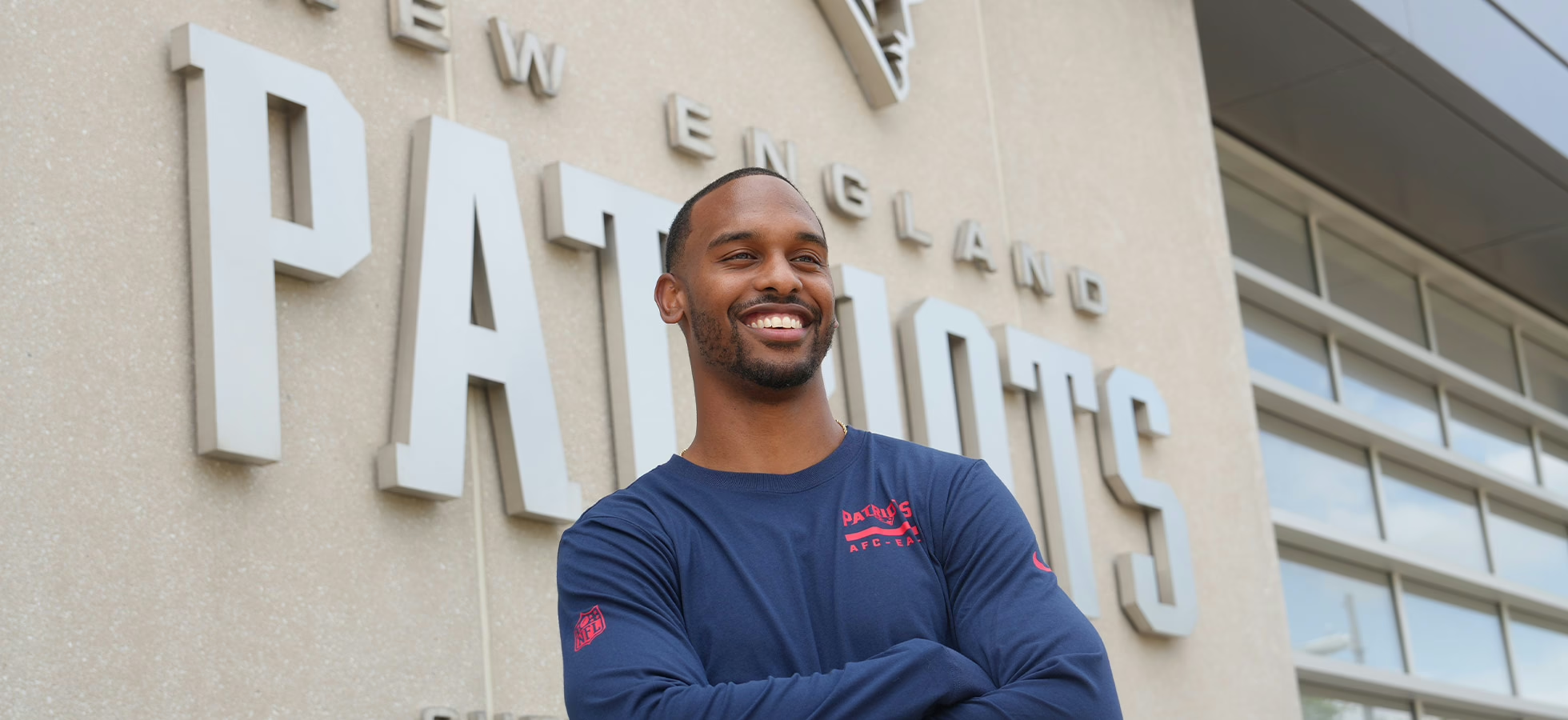
Ashton Grant ’19’s path from Assumption standout to the New England Patriots’ quarterbacks coach is a story of drive, discipline, and destiny.
In 2024, Ashton Grant ’19 found himself in the last row on a plane to West Virginia next to former New England Patriot Mike Vrabel. It wasn’t just a coincidence. The flight was chartered by the Cleveland Browns and was on its way to The Greenbrier — a secluded retreat in Appalachia where professional teams spend time training.
Grant, one of the greatest football players in Assumption history, had coached with the Browns since 2020. His seatmate Vrabel, a three-time Super Bowl champion, former All-Pro linebacker, and NFL Coach of the Year, had just joined the Browns’ staff as a consultant after completing a successful six-year tenure with the Tennessee Titans.
“Ash, life comes at you fast,” Vrabel said to Grant wryly. “Three months ago, I was in seat 1A; now I’m in 34B by the bathroom with you.”
Despite this temporary pause in his coaching career, Vrabel was soon to be one of the NFL’s most desirable head coaching candidates. He would have his pick of compelling opportunities throughout the league, but it seemed destined that he would return to the New England Patriots — the franchise where he had found so much success as a player — and perhaps it was kismet that Grant got the chance to work alongside him during his brief time with the Browns.
“I remember when the news broke,” Grant says about Vrabel’s acceptance of the Patriots head coaching role. “I decided to text him something like, ‘congratulations on making it back to seat 1A.’”
Grant, who hails from Manchester, Connecticut, didn’t grow up as a Patriots fan. He rooted for his stepfather’s favorite, the Philadelphia Eagles. But his journey onto the coaching staff of one of the region’s highest profile institutions is a quintessentially New England one.
Bob Chesney, Assumption’s head football coach from 2013-17, first scouted Grant at a game between Bridgton Academy and East Coast Prep, where Grant played amid the Berkshires’ densely wooded hills. It was clear even then that the 6’2” wide receiver would be electrifying. Grant had all the physical traits — strength, size, and speed — but from the beginning, his character and intellect stood out most — traits that continue to inform his coaching practice today.
At Assumption, Grant led the Greyhounds in winning multiple Northeast-10 (NE10) Conference championships. He earned first-team all-conference honors twice and was named 2016 NE10 Offensive Player of the Year in the same season he set the school’s receiving touchdowns record with 13. He also holds career receiving yards records at 3,204 and total receiving touchdowns at 36.
Opportunity Rings
In addition to being a standout student-athlete, Grant was thoroughly involved in the life of the University, serving as an orientation leader and admissions ambassador. He says that these opportunities helped him get out of his comfort zone and have helped with his confidence in coaching.
“Coaching wasn’t something I was thinking about back then, but those experiences helped a lot,” he says. “I was able to connect with people who come from different backgrounds than I do and work on public speaking — talking to an audience and controlling a room. I think all of those opportunities helped lead me to where I am now.”
As one of the most dynamic athletes ever to don the Blue and White, Grant drew plenty of interest from NFL scouts — even while he was still involved on campus.
“I think I was giving a tour when I got a call from a scout from the Tampa Bay Buccaneers,” says Grant. “I remember calling my mom after that and saying, ‘Wow, the Bucs called me.’ That was pretty neat.”
After his time at Assumption, Grant would go on to participate in training camps with the Chicago Bears and Kansas City Chiefs before briefly playing in the Alliance of American Football. But it wasn’t long before he turned his attention to coaching. When he returned to Assumption to finish his degree in criminology, he reconnected with his old coach, Chesney. Chesney had moved across the city to the College of the Holy Cross and quickly added his former star player to his coaching staff.
“He’s one of those players who transformed a whole culture and our team,” Chesney told ESPN in February. “So, if he wanted to be on our staff, I wanted him on our staff, wherever it was going to be.”
The work ethic and extreme drive Grant showcased as a player translated to his start in coaching with the Holy Cross Crusaders. It also drew the attention of Cleveland Browns’ head coach Kevin Stefanski, who recruited Grant for the Bill Willis Coaching Fellowship.
Over five seasons in Cleveland, Grant ascended quickly, first serving as offensive quality control coach, working with running backs, tight ends, and receivers; then as offensive assistant and quarterbacks coach. He helped lead a dynamic Cleveland offense to multiple milestones, including Comeback Player of the Year for Super Bowl-winning quarterback Joe Flacco and AFC Offensive Player of the Week honors for Heisman Trophy-winner Jameis Winston.
During their time together with the Browns, Grant’s acumen caught the attention of Vrabel, whose consulting responsibilities included developing younger coaches.
“I would have to go into a room and do a job interview,” Grant says. “[Vrabel] would tell me, ‘Ashton, I need you to teach me four concepts on Friday,’ and I would have to get up and teach plays, teach drills. Then they would hammer you with their feedback, telling me to think about different things while teaching, make sure to ask questions, make sure the audience understands what it is you’re saying. That kind of started our relationship — then, halfway through the season, Coach Vrabel and I had a more hands-on role during game day — so we were able to work hand in hand.”

From Salisbury Street to Patriot Place
In his role as the Patriots’ quarterbacks coach, Grant is now tasked with developing one of the most promising players in the NFL today, Drake Maye. Grant is expected to act as a mentor for Maye, working on improving his technique, timing, and decision-making, as well as teaching him the play-calling system and ensuring his development on and off the field.
“My job at the end of the day is to help him be the best quarterback he can be,” Grant says. “Whether that’s giving him tools to connect, preparing him for a game, helping him with his study habits … it’s all encompassing.”
Grant comes from a distinctly different background than Maye —Division II Assumption versus Division I University of North Carolina at Chapel Hill. This difference has helped Grant help Maye, giving him the perspective of someone coming from a small, liberal arts college instead of a bigger program.
“Drake Maye has been a big fish in a small pond for a lot of his life, so it’s neat to be able to show him the other side of the coin,” Grant says. “Understanding what somebody else might have gone through can help him connect with some of his teammates.”
Grant isn’t the only coach from Assumption who can offer that perspective to players. Brian Kelly ’83 was the head football coach at Louisiana State University after previously coaching at the University of Notre Dame, Kyle Barnes ’18 is the nickels coach at James Madison University, and Charles Williams ’17 is the defensive recruiting coordinator and defensive line coach at Central Connecticut State University.
“There’s a ton of Assumption alumni that are coaching, and because it’s such a small campus, everyone talks to everyone, and we can stay in contact with each other,” Grant says. “You start to create relationships that forge themselves. You create bonds.”
These bonds, Grant says, help to keep him — and, in turn, Maye — sharp on game days.
“Coaching is about how much information you can gather and then give to your players. If I can stay in contact with as many coaches as possible, hear their different experiences — we can all give each other information,” Grant says. “The more information you get, the more you can relate to your players, and I think that, in turn, ends up helping your players out.”
What Grant says is most rewarding for him about being a coach is the moment when all that information begins to click in the players — the epiphany, when players apply the advice he’s given them, and everything starts to make sense.
“At this level, we’re called coaches, but it’s kind of like we’re guidance counselors. We’re trying to herd them in the right direction and give them advice,” he says. “Coaches and professional athletes are more like peers working together. We’re on the same level. I just try to relate and help these guys out.”
