
The Brains Behind the Bizarre: Professor Lauren Crockett-Girard Shares Her Undead Expertise
Visiting Assistant Professor of English Lauren Crockett-Girard ’19 is probably the most prepared person on Assumption’s campus for Halloween. Her scholarly work focuses on a topic that seems to come up around this time every year: zombies. Specifically, how the zombie is an outlet for cultural fears and how these monsters—and other Halloween creatures—are actually effective in bringing people together. Last year, she defended her Ph.D. thesis at Boston College, titled “Thinking with Zombies: How Zombie Rhetoric Infected American Discourse”.
Crockett-Girard answered a few questions about her expertise in the spirit of the season.
How did you end up studying zombies and horror, and what’s the reaction when you tell people what you do?
Ever since I was little, I’ve always been drawn to scary things! But my academic interest in zombies didn’t begin until I took a class on The Walking Dead with Professor Kristen Carella here at Assumption. The paper I wrote in that class became the paper I used in my PhD program applications, and my interest in zombies continued throughout my graduate work.
Typically, people react with a mix of surprise, disbelief, and sometimes excitement. I get it—studying zombies sounds a bit out there! But I love having the opportunity to tell people that zombies are more than flesh-eating Hollywood monsters. The zombie has its roots in Haitian folklore, with deep ties to the history of slavery and colonialism. I love that zombies get people talking, and it gives me a chance to share a little bit about the zombie’s history and the work I’m so passionate about.
Why do we seek out being scared at Halloween? What’s the appeal of fear we can switch off?
I think there are many reasons that people enjoy being scared. Some people just enjoy the adrenaline rush of a scare actor lunging at them with a hatchet, of course—but I also think that fear we can choose to participate in is fear that we can control. For me (and for many of the horror fans that I’ve spoken to), horror films and frightful experiences can help us channel ambiguous anxieties and fears into something we can see and name. Experiencing fear or anxiety in a controlled environment—an environment we can walk away from—may give us a chance to process some of those feelings in a safe way. Sometimes, I even find that horror films are comforting!
How do horror movies and their monsters help a culture process fears it can’t easily face head-on?
Cultures make monsters to symbolize many things, but especially our fears, anxieties, and taboos. Normally, these things are intangible and hard to confront on a cultural level, but monsters—and horror movies more broadly—help us create a version of that thing that we can name and confront. Monsters are also mirrors; they reflect the very worst parts of our culture back to us. This is some of the biggest cultural work that zombies do. They can reflect our fears about losing our individuality, our autonomy, or even our humanity. A good monster reminds us of ourselves in a way that makes us reflect on who we are, what we fear, and what we value.
Can you give an example of a classic movie monster that clearly reflected the anxieties of its moment?
George A. Romero’s zombies in Dawn of the Dead (1978) are often read as an overt metaphor for overconsumption. The film, set in a quintessential American shopping mall, used the zombie to symbolize the fear and anxiety that Americans were being reduced to insatiable, mindless consumers of things. The zombies stagger around the shopping mall, hunting for human flesh; but many of the humans in the film also give in to their own greed and desires. By the end of the film, we’re left questioning if the real monsters are the zombies or the humans.
What is it about zombie and horror fandom that creates such strong communities, from conventions to costume meetups to movie marathons?
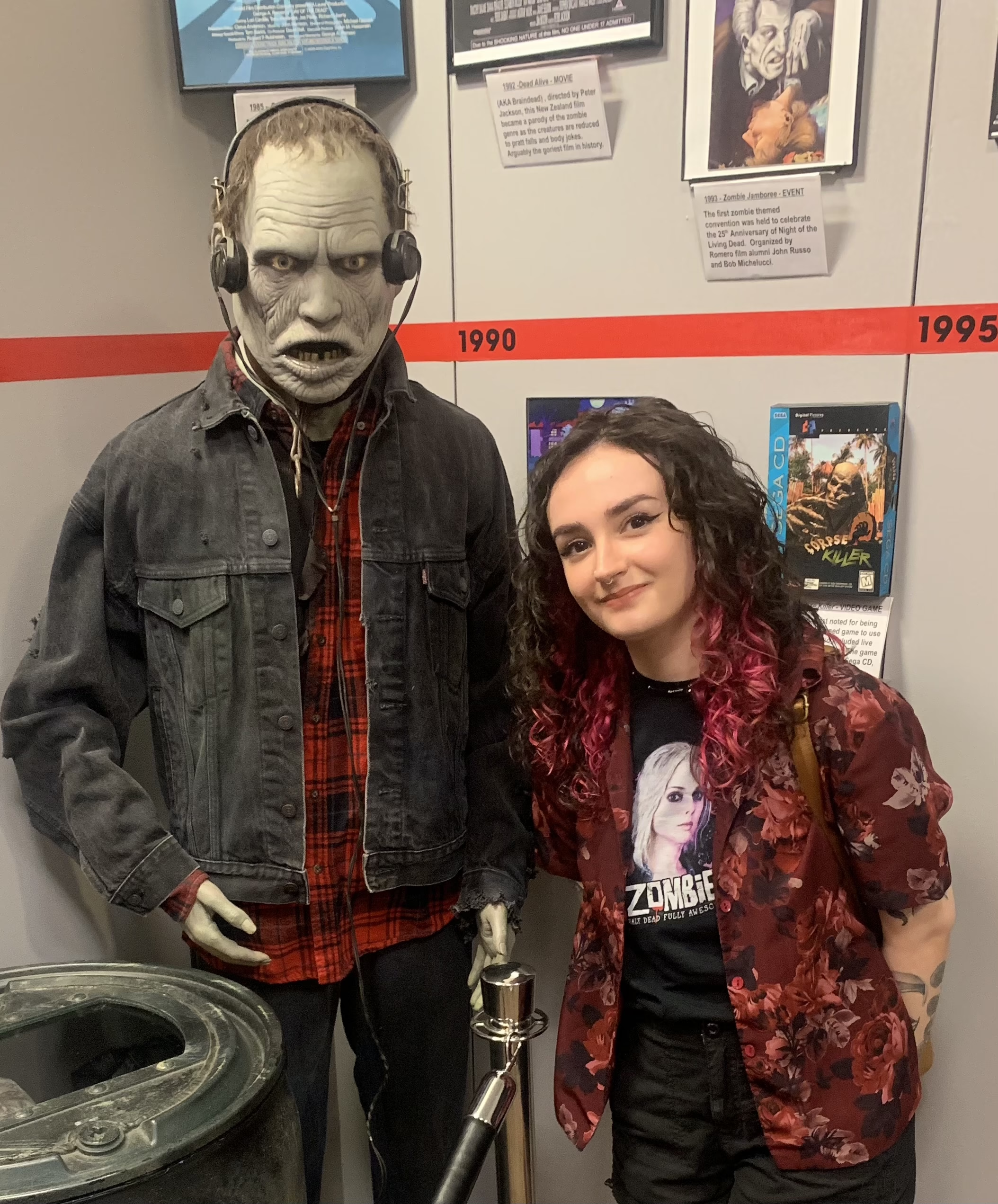
Crockett-Girard at Living Dead Weekend with a new…friend.
This was a big research question that I had when I traveled to Living Dead Weekend, a zombie convention held in the Monroeville Mall in Monroeville, PA—the setting of Romero’s Dawn of the Dead. In general, fandoms are great at creating community. Fandoms create spaces for people to meet and bond over shared interests, and there’s often less social pressure to be nonchalant about something you’re passionate about. Many fandoms have active fanart and cosplay communities that add a creative element to the shared experience of enjoying some kind of media together.
For zombie and horror fandoms, I think there’s an additional sense of belonging that comes from sharing interests that might otherwise be seen as weird, creepy, or unconventional. There’s a lovely irony to the fact that zombies, monsters that have lost their humanity, are capable of bringing people together in this way. At Living Dead Weekend, I saw all kinds of people come together over their shared love of zombies. Exploring some of Dawn of the Dead’s original filming locations with other fans made the movies feel real and tangible in a way that I wasn’t expecting. Ultimately, zombie and horror fandoms help people connect with each other and get excited about the things they love, even if those things seem weird or unusual to some people.
Watch Crockett-Girard talk more about the origins of Halloween on Spectrum News here!